
-

 Proveedor:B. Braun
B. Braun Vasofix® Braunüle® Venel Defense Cánula - 1 pieza
Features: Material mixto
Unit price: 0,010 €0,017 € / piecePrecio habitual A partir de 0,83 € A partir de 0,83 €Precio de oferta A partir de 0,83 € A partir de 0,83 € Precio habitualPrecio unitario 0,00 € por0,83 € 0,83 €plus shipping
Entrega
-

 Hasta 9% de descuentoProveedor:B. Braun
B. Braun Vasofix® Safety Pur Braunüle® Venel Desviando copas - 1 pieza
Features: Material compuesto
Unit price: 0,020 €0,020 € / piecePrecio habitual A partir de 1,01 € A partir de 1,01 €Precio de oferta A partir de 1,01 € A partir de 1,01 € Precio habitualPrecio unitario 0,00 € por1,01 € 1,01 €plus shipping
Entrega
-

 Hasta 33% de descuentoProveedor:B. Braun
B. Braun Vasofix® Cánula de vena de seguridad de seguridad
Features: Material mixto
Discount −33 %Unit price: 0,010 €0,017 € / piecePrecio habitual A partir de 0,83 € A partir de 0,83 €Precio de oferta A partir de 0,83 € A partir de 0,83 € Precio habitualPrecio unitario 0,00 € por0,90 € 0,90 €was
1,24 €1,24 €you save 0,41 €0,41 €plus shipping
Entrega
-
 Proveedor:W. Söhngen GmbH
Estilete para Vasofix marrón tubo 0,9 y 08 G 22 azul | Paquete (50 piezas)
Precio habitual 2,87 € 2,87 €Precio de oferta 2,87 € 2,87 € Precio habitualPrecio unitario 0,00 € por2,87 € 2,87 €plus shipping
Entrega
-
 Proveedor:W. Söhngen GmbH
Tubo Vasofix marrón Safety G 18 - 1,3 verde-blanco 33 mm | Paquete (1 pieza)
Precio habitual 5,65 € 5,65 €Precio de oferta 5,65 € 5,65 € Precio habitualPrecio unitario 0,00 € por5,65 € 5,65 €plus shipping
Entrega
-
 Proveedor:W. Söhngen GmbH
Tubo Vasofix marrón Safety G 17-1,5 blanco | Paquete (1 pieza)
Bajas existenciasPrecio habitual 5,83 € 5,83 €Precio de oferta 5,83 € 5,83 € Precio habitualPrecio unitario 0,00 € por5,83 € 5,83 €plus shipping
Entrega
-
 Proveedor:W. Söhngen GmbH
Vasofix tubo marrón Safety G 20 - 1.1 25 mm rosa | Paquete (1 pieza)
Precio habitual 6,70 € 6,70 €Precio de oferta 6,70 € 6,70 € Precio habitualPrecio unitario 0,00 € por6,70 € 6,70 €plus shipping
Entrega
-
 Proveedor:W. Söhngen GmbH
Vasofix tubo marrón Safety G 14-2.2 naranja | Paquete (1 pieza)
Precio habitual 7,02 € 7,02 €Precio de oferta 7,02 € 7,02 € Precio habitualPrecio unitario 0,00 € por7,02 € 7,02 €plus shipping
Entrega
-
 Proveedor:W. Söhngen GmbH
Estilete para tubo Vasofix marrón 1,5 y 1,4 G 17 blanco, PU 50 | Paquete (50 piezas)
Precio habitual 70,75 € 70,75 €Precio de oferta 70,75 € 70,75 € Precio habitualPrecio unitario 0,00 € por70,75 € 70,75 €plus shipping
Entrega
-
 Proveedor:W. Söhngen GmbH
Tapón de sellado para tubos marrones rojo | Paquete (1 pieza)
Precio habitual 2,16 € 2,16 €Precio de oferta 2,16 € 2,16 € Precio habitualPrecio unitario 0,00 € por2,16 € 2,16 €plus shipping
Entrega
-
 Proveedor:W. Söhngen GmbH
Vasofix tubo marrón Safety G 22-0.9 azul | Paquete (1 pieza)
Precio habitual 7,02 € 7,02 €Precio de oferta 7,02 € 7,02 € Precio habitualPrecio unitario 0,00 € por7,02 € 7,02 €plus shipping
Entrega
-
 Proveedor:W. Söhngen GmbH
Estilete para tubo Vasofix marrón 1,7 G 16 gris, PU 50 | Paquete (50 piezas)
Precio habitual 70,75 € 70,75 €Precio de oferta 70,75 € 70,75 € Precio habitualPrecio unitario 0,00 € por70,75 € 70,75 €plus shipping
Entrega
-
 Proveedor:W. Söhngen GmbH
Tubo Vasofix marrón G 17-1,5 blanco | Paquete (1 pieza)
Precio habitual 3,95 € 3,95 €Precio de oferta 3,95 € 3,95 € Precio habitualPrecio unitario 0,00 € por3,95 € 3,95 €plus shipping
Entrega


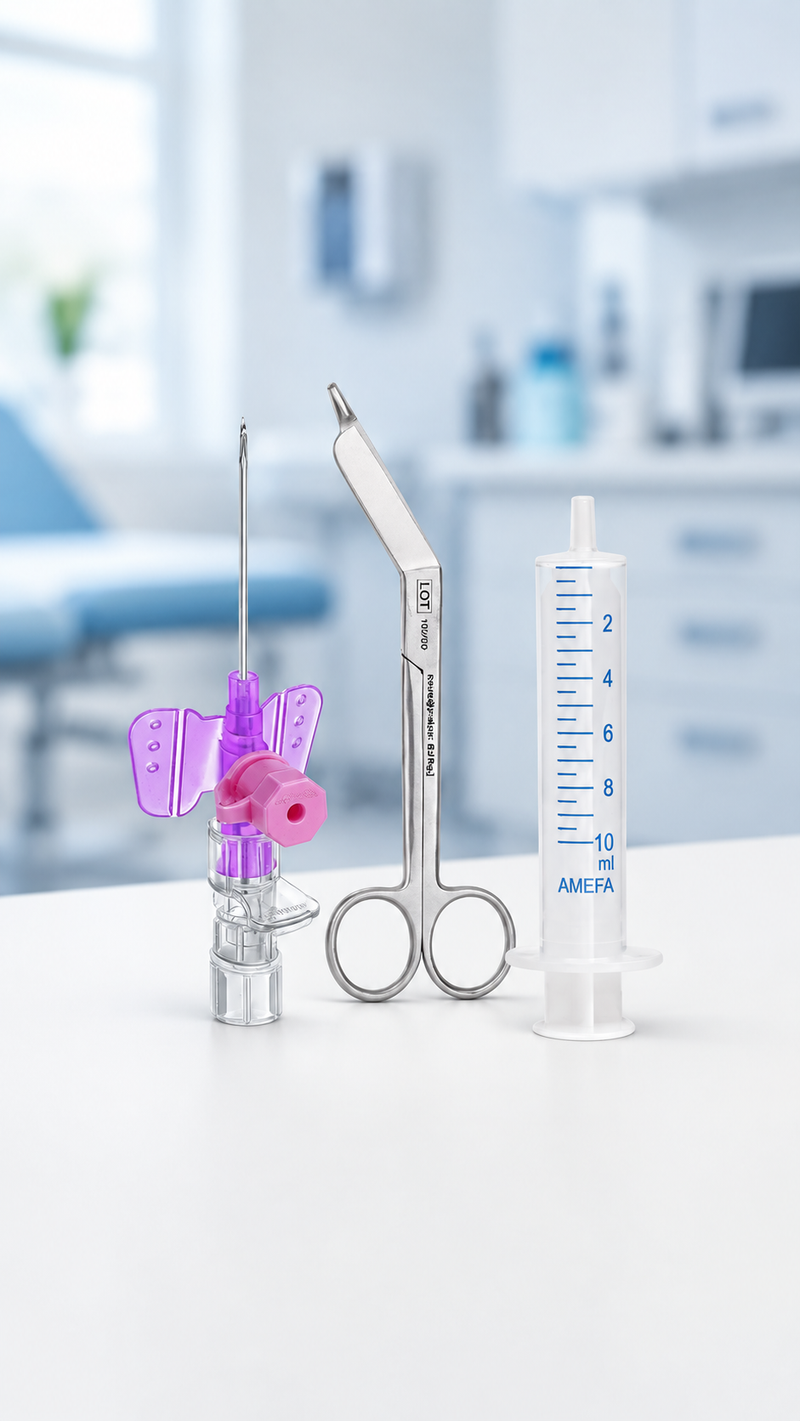


Las vías venosas permanentes de seguridad son herramientas fundamentales de la medicina moderna que se utilizan a diario en numerosos centros, como hospitales o residencias de ancianos. Las vías venosas permanentes están diseñadas específicamente para establecer un acceso rápido y duradero a una vena del paciente. Este procedimiento es esencial para la administración de medicamentos y líquidos, así como para la extracción de sangre durante un periodo prolongado.
Estructura y funciones de las cánulas venosas de permanencia
Las cánulas venosas de permanencia consisten en un tubo fino de plástico que se introduce en la vena del paciente mediante una aguja. Una vez realizada la punción con éxito, se puede retirar la aguja y el tubo permanece en la vena. Esto permite que, a largo plazo, los medicamentos o los líquidos lleguen directamente al torrente sanguíneo del paciente. Las cánulas venosas de permanencia tienen múltiples aplicaciones. Resultan especialmente útiles en situaciones en las que se requiere un tratamiento intravenoso continuo o repetido. Este puede ser el caso, por ejemplo, de la quimioterapia, los tratamientos contra el dolor o las infecciones que requieren una administración de líquidos a largo plazo.
La diferencia con respecto a otros tipos de cánulas
- Las cánulas venosas de permanencia se diferencian de otros tipos de cánulas, como por ejemplo las cánulas de punción venosa. Estas últimas están diseñadas para una punción única y no están previstas para punciones prolongadas o repetidas.
- Asimismo, se diferencian delas cánulas de inyección . Estas están diseñadas para la inyección subcutánea de medicamentos. A diferencia de las cánulas venosas de permanencia, solo se utilizan una vez para la inyección y no están pensadas para un uso repetido o prolongado.
Agujas venosas de permanencia de seguridad para mayor seguridad
Las agujas venosas de
permanencia de seguridad están equipadas con un mecanismo especial que reduce el riesgo de lesiones por pinchazo de aguja. Las agujas venosas de permanencia están diseñadas para facilitar la técnica de punción con una sola mano. Este mecanismo simplifica la introducción de la aguja. De este modo, se puede insertar con una mano, mientras que con la otra se estabiliza el brazo del paciente. Esto no solo facilita el manejo en general, sino que también mejora la precisión y la seguridad durante la punción venosa. Otro mecanismo de seguridad de las cánulas venosas de permanencia de seguridad es el clip de seguridad autoactivable. Este dispositivo garantiza que, al retirar la aguja de la vena, la punta de la misma quede cubierta, minimizando así el riesgo de pinchazos accidentales. El día a día de la práctica médica se caracteriza constantemente por situaciones estresantes en las que pueden producirse pinchazos accidentales con facilidad. El uso de una cánula venosa de seguridad garantiza un tratamiento seguro y eficaz.Conclusión sobre las cánulas venosas de permanencia
Las cánulas venosas de permanencia son esenciales en cualquier centro médico moderno. Facilitan considerablemente el trabajo diario del personal médico gracias a la técnica de punción con una sola mano y a la tecnología de clip de seguridad autoactivable. Las cánulas venosas de permanencia garantizan un tratamiento seguro para el paciente y un manejo seguro para el personal médico. Elija entre la amplia selección decánulas , ,en , Altruan , y descubra otros productos relacionados con la salud.


